
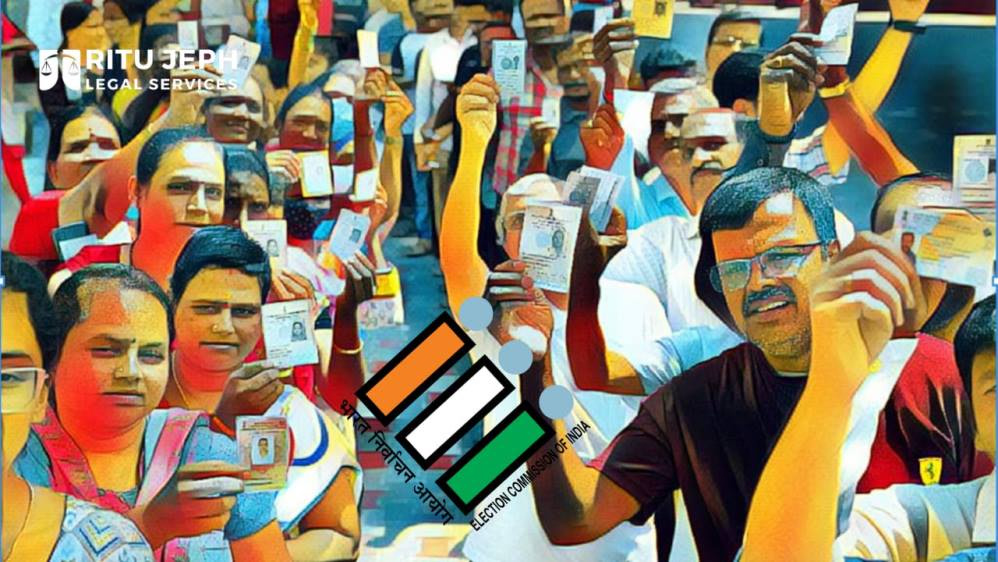
The Union Law Ministry’s recent amendment to Rule 93 of the Conduct of Election Rules, 1961, has sparked widespread debate about its impact on electoral transparency. The amendment, notified on December 20, 2023, restricts public access to certain election-related documents, raising concerns among political parties, legal experts, and civil society groups.
What Does the Amendment Change? The amendment to Rule 93(2)(a) limits the types of "papers" or documents available for public inspection. While earlier rules allowed broader access to election records, the new provisions restrict access to only specific documents explicitly mentioned in the rules. These include certain paper-based records while excluding electronic records such as videography, CCTV footage, and other forms of electronic data from polling stations.
The Rationale Behind the Amendment According to officials, the amendment aims to protect the electoral process from potential misuse or manipulation of electronic records. The government argues that making sensitive data like CCTV footage publicly accessible could lead to the creation of false narratives or doctored evidence that undermines public trust in the electoral process.
The High Court Case That Sparked the Debate This amendment comes in the wake of a Punjab and Haryana High Court direction to the Election Commission to provide records, including CCTV footage and Forms 17-C Parts I and II, related to the Haryana Assembly elections. Advocate Mehmood Pracha had petitioned for access to these records to verify the integrity of the election process. Critics argue that the timing of the amendment suggests an attempt to restrict such scrutiny.
Criticism from Political Leaders and Civil Society The amendment has drawn sharp criticism, particularly from the Indian National Congress, which has filed a petition in the Supreme Court challenging the move. Congress leader Jairam Ramesh expressed concerns on social media, stating, “The Election Commission, a Constitutional body, charged with the conduct of free and fair elections cannot be allowed to unilaterally amend such a vital law without public consultation. The integrity of the electoral process is fast eroding.”
Civil society groups and legal experts share similar concerns, arguing that the amendment undermines transparency, which is essential for free and fair elections. Critics contend that restricting access to key records reduces public oversight and raises questions about accountability in the electoral process.
Implications for Electoral Transparency By limiting public access to electronic records, the amendment affects the ability of stakeholders, including candidates, political parties, and watchdog organizations, to scrutinize elections. Documents like CCTV footage and Forms 17-C play a crucial role in verifying the fairness of polling activities, especially in contested constituencies. Restricting access to such information could hinder efforts to address potential electoral malpractices.
The Role of the Supreme Court The Supreme Court is now expected to weigh in on the matter. Its decision could have far-reaching implications for electoral transparency and the balance between protecting sensitive data and ensuring public access to essential election records. Many are hopeful that the Court will help restore confidence in the electoral process by addressing the concerns raised by this amendment.
Balancing Integrity and Transparency While protecting election records from misuse is important, it is equally critical to ensure that restrictions do not compromise public trust. Transparency and accountability are the cornerstones of a healthy democracy. Any measures that reduce public oversight must be carefully considered and implemented in consultation with stakeholders to avoid undermining these principles.
Conclusion The amendment to Rule 93 of the Conduct of Election Rules, 1961, has reignited the debate on electoral transparency in India. While the government defends the move as necessary to safeguard the integrity of electronic records, critics see it as a step backward for public accountability. As the Supreme Court takes up this issue, its verdict will likely shape the future of transparency in India’s electoral process. Conduct of Election Rules and Rule 93 of the Conduct of Election Rules
Share Your Love



Related Posts