
When a crime happens in India, and the police file a case, the matter goes to a criminal court. The judge cannot decide anything without hearing from witnesses - people who saw what happened, people who can tell the truth under oath. Witnesses are not optional. They are the foundation on which a criminal trial stands.
Now, a simple question that almost nobody in the legal establishment asks aloud: what does it actually cost an ordinary person to be a witness?
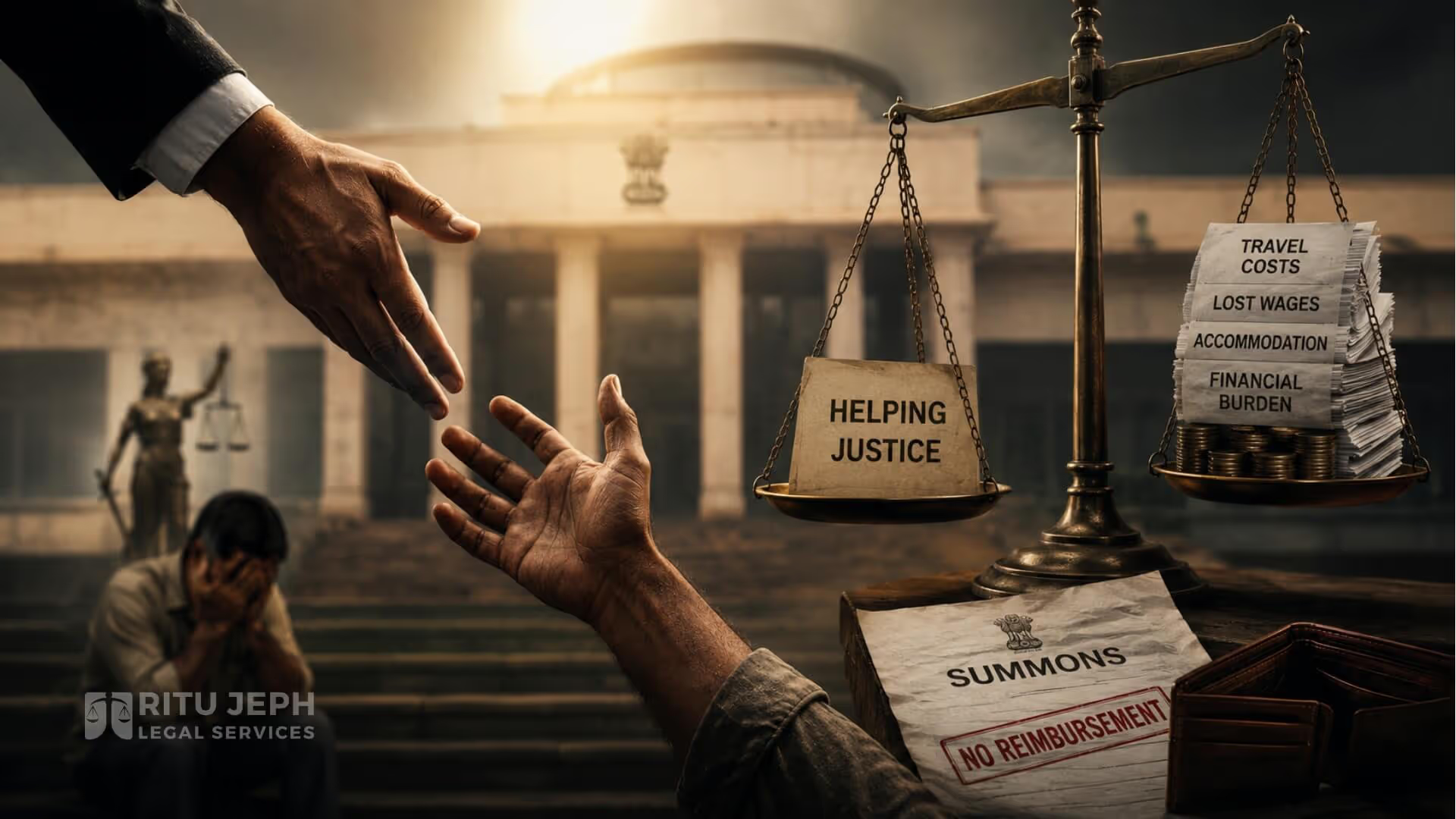
Consider this. You live in a village fifty kilometers from the nearest district court. You get a summons. You spend money on a bus. You lose a full day's wages. The case gets adjourned - because in Indian courts, that is the default setting. You come back next month. And the month after. And the month after that. Each time, you pay from your pocket. Each time, you lose income you cannot afford to lose.
For a daily wage worker, one court visit is not an inconvenience. It is a meal. Or school fees. Or medicine.
This is not a hypothetical. It plays out every single day, in every district court. And it is one of the main reasons criminal cases stretch into decades, acquittals pile up, and ordinary people quietly conclude that the justice system was not built for them.
Most legal commentary asks: what are witness expenses under Indian law? Useful question. But the one that actually stings is this:
Can India expect poor citizens to keep delivering justice, when delivering it costs them more than they earn?
Section 350 of the Bharatiya Nagarik Suraksha Sanhita (BNSS) —India's new criminal procedure code that replaced the CrPC in 2023—attempts to tackle this. But the provision says "may." And that single permissive word has, for five decades, let the State off the hook.
Why Witnesses Disappear
Before examining the law, it is worth sitting with the problem itself.
Think of a witness as someone who never asked to be in this fight. They did not commit the crime. They did not file the case. But the court requires them. A summons lands - a formal piece of paper asking them to appear on a date - and they have no choice.
Here is what actually happens, more often than not:
They travel, sometimes from absurd distances. They reach court and wait for hours in a corridor that probably does not even have benches. When their case is finally called, the defence counsel asks for a routine adjournment. The judge grants it. The new date is three weeks away. Nobody pays the witness for the day they just lost.
Three weeks become three months. Three months become three years. Witnesses tire of this circus. They stop turning up. Cases stall. Justice, already sluggish, grinds to a halt. And when enough time passes, the judge has no option but to acquit or close the matter.
The Supreme Court flagged this decades ago. In Swaran Singh vs State of Punjab (AIR 2000 SC 2017), the Court bluntly observed that witnesses are harassed. They come from far-off places, find the case adjourned, attend repeatedly at their own cost, and eventually - simply out of exhaustion - stop coming. The Court also noted that even when payments are ordered, they are rarely disbursed on time.
In State of U.P. vs Shambhu Nath Singh (AIR 2001 SC 1403), the Supreme Court put it more poetically. Witnesses, it said, ought to be treated as "guests invited" by the court to assist in delivering justice. Instead, they are made to appear repeatedly, losing their livelihood each time, only to be sent back without their testimony even being recorded. The Court called this an "unfortunate reality" in trial courts across India. That was in 2001. Twenty-five years later, nothing has changed.
Financial strain is not the only reason witnesses turn hostile or vanish. Fear of the accused, absence of protection, community pressure - these all play a part. But the money problem is the one that hits the largest number of people. And it hits the poorest the hardest.
Fifty-Four Million Cases, and a Million Tired Witnesses
As of January 2026, India has over 54 million pending cases across all courts. A significant chunk of these is stalled precisely because witnesses are either not appearing or have turned hostile meaning they change their version on the stand.
In Mahendra Chawla vs Union of India (2019) 14 SCC 615, the Supreme Court described the condition of witnesses as "pathetic." The Court observed that witnesses rarely change their statements voluntarily. They do so because of threats, pressure, or sheer neglect by the State. No one supported them through the process. No one reimbursed them. So, when the accused offers a little money or a quiet threat, the witness has little incentive to stay steadfast.
Even more sharply, in Zahira Habibullah Sheikh vs State of Gujarat (2006) 3 SCC 374, the Supreme Court noted that witnesses are regularly turned hostile through coercion, money, political influence, and intimidation by people with power. The Court called this a systematic effort to suppress truth.
When powerful people can weaponise the witness's own poverty and exhaustion against them, the trial ceases to be a search for truth. It becomes a contest of attrition. And the ordinary witness always loses that contest.
Section 350 BNSS: What It Says, and What It Doesn't
Here is the exact text of Section 350 BNSS:
"Subject to any rules made by the State Government, any Criminal Court may, if it thinks fit, order payment, on the part of the Government, of the reasonable expenses of any complainant or witness attending for the purposes of any inquiry, trial or other proceeding before such Court under this Sanhita."
Now, in plain language: the court can direct the government to pay a witness's reasonable expenses - travel, daily allowance, any out-of-pocket costs. Both complainants and witnesses are covered.
The money comes from the State, not from either party.
Now watch the trap: the provision says "may, if it thinks fit."
"May" is permissive. It is not mandatory. There is no automatic entitlement. There is no guarantee. Whether a witness gets reimbursed is entirely a matter of judicial discretion - whether the particular judge, on that particular day, chooses to order it.
If the law said "shall," the witness would have a right. Because it says "may," they have a hope. And hope, as every regular court-goer knows, does not buy a bus ticket.
This Provision Is Older Than Most Lawyers Practicing Today
Here is a fact that rarely makes it into the commentary: Section 350 BNSS is not a reform. It is a photocopy.
It is virtually identical to Section 312 of the Code of Criminal Procedure (CrPC), 1973. The only substantive change is the word "Sanhita" replacing "Code" at the end. Everything else - the discretionary power, the "may," the dependence on State rules—is untouched.
And the CrPC itself inherited this from earlier iterations. The 14th Law Commission Report of 1958 - yes, 1958—first drew attention to the plight of witnesses and recommended that courts ensure payment of travelling allowances and daily expenses. Nearly forty years later, the 154th Law Commission Report of 1996 again highlighted the same issue: witnesses need basic facilities, including fair travelling allowances.
So Parliament knew in 1958. They legislated in 1973. Law Commissions kept reminding them in 1996. And in 2023, when the BNSS was passed, the provision was carried forward with barely a word changed.
The question is no longer whether the legislature is aware. The question is why, after sixty-seven years of awareness, the system still treats witnesses like an afterthought.
Three Reasons the Law Stays Dead on Paper
Why does a provision that has existed for over half a century still fail most witnesses? Three reasons.
One: "May" is a convenient escape hatch.
Busy trial judges handle hundreds of cases. Witness expenses rarely feature on the radar unless someone raises the issue. A daily wage worker who does not even know the provision exists will not ask for it. A judge, pressed for time, will not volunteer it. The result: the provision simply lies unused.
Two: State rules are a mess—where they exist at all.
Section 350 explicitly says payment is "subject to any rules made by the State Government." That means every state is supposed to frame its own rules on how much to pay, how to calculate expenses, and how to disburse the money.
Some states have framed these rules. Many have not. And among those that have, the amounts are often a joke.
Example: the Tripura Criminal Procedure Rules, 1972—still in force—prescribed a daily allowance of Rs. 6 to Rs. 10 for labourers and ordinary workers. West Bengal's 1981 rules gave Rs. 4 to Rs. 15 depending on income. Odisha's 2012 rules prescribed Rs. 100 per day.
Rs. 100 in 2025? That does not cover a one-way auto ride in most cities, let alone a day's lost wages for a construction worker. These rules are not just outdated - they are insulting.
Three: No national standard means a lottery by geography.
Because each state makes its own rules (or sits on its hands), a witness's reimbursement depends entirely on where they live. A witness in one state might get something. A witness in the neighbouring state might get nothing, because their government never bothered to frame the rules. There is no baseline, no monitoring, no accountability.
What Fixing This Would Actually Take
The flaws in Section 350 are not obscure. They have been documented in Law Commission reports, flagged by Supreme Court judges, and studied by researchers. The problem is not lack of knowledge - it is lack of will.
A real fix would look something like this:
Replace "may" with "shall" in appropriate cases. At a minimum, the law should require courts to consider witness expenses in every case involving a person from a vulnerable economic background. Not leave it to chance. Not wait for the witness to ask.
State rules must be dragged into the present. Paying a witness Rs. 6 or Rs. 10 a day in 2026 is not just inadequate - it is farcical. States must revise their rules to reflect actual transport costs and actual daily wages, and must update them regularly, the way minimum wages are revised.
Set a national floor. Parliament can, under the BNSS, establish a minimum standard for witness reimbursement that applies across all states. States can always pay more. They should not be allowed to pay less - or nothing at all.
Trial courts must become proactive, not passive. Judges cannot chase every administrative detail, but they can be trained and encouraged to ask the basic question: "Has this witness been paid for today?" It costs nothing to ask.
Simplify the payment process. Even where rules exist, collecting the money is often a bureaucratic nightmare - multiple visits, multiple forms, multiple delays. A witness who lost a day's wage should not have to lose another day just to claim a paltry reimbursement.
The Deeper Cost of Doing Nothing
There is an old principle that underpins any functioning legal system: justice must be accessible to everyone, not priced only for those who can afford it.
When a daily wage worker from a village loses two days' income every month for three years because a court keeps summoning them - and never pays them a rupee—that worker is quietly subsidising the justice system with their own poverty. They are paying, in real terms, for the State's failure to do what the law already says it can do.
And when this happens often enough, word spreads. People stop reporting crimes. People stop coming forward. And when an accused person says, "Don't show up," the witness listens - because showing up was already costing them too much, with nothing to show for it.
That is the hidden cost of the gap between Section 350 on the statute book and Section 350 in the courtroom. It is not just a cost to the individual witness. It corrodes the entire system. It erodes public trust. And it tells every poor citizen, in the clearest possible terms, that this system was not built for them.
The law has known this since 1958. The provision to fix it has been on the books since 1973. What we still lack is not a solution - it is the basic seriousness to implement one.
Share Your Love

Related Posts